
Our Service
What a Basement Floor Coating Does, and the One Test That Makes It Last
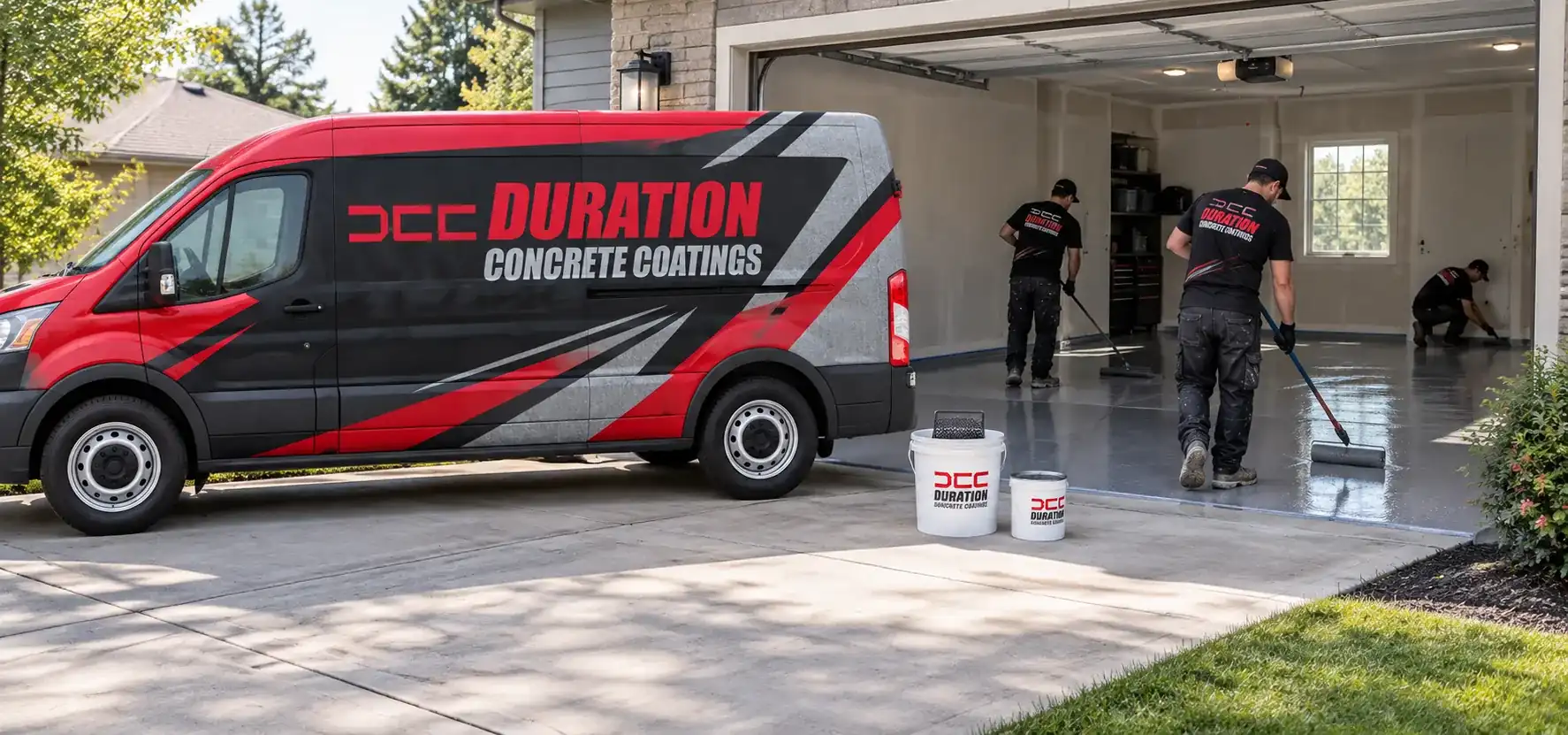
A basement floor coating seals and finishes your slab so it is warmer underfoot, easy to clean, and resistant to the damp, musty conditions a bare basement floor invites. In Fort Wayne the make-or-break step is moisture. Northeast Indiana sits on a high water table, and vapor pushing up through a below-grade slab is the number-one reason basement coatings fail. That is why we moisture-test every basement floor before we coat it and install a mitigation primer where the slab needs one. We give a free on-site estimate, and most basements are ready for full use in about 24 hours.
Why Fort Wayne Basements Need a Moisture-Aware System
- High water table. Ground water sits close to the surface across much of Allen County, so below-grade slabs stay damp and pass vapor upward.
- Hydrostatic and vapor pressure. That moisture pushes up through the concrete. A coating that is not rated for it lifts and bubbles.
- Humidity and temperature swings. A basement cycles between damp summers and dry, heated winters, which stresses a coating that cannot flex.
A coating slapped on without a moisture test looks fine for a season and then blisters. Testing first is cheap insurance, and it is standard on every basement we do.
How We Coat a Basement Floor
Grind
Diamond-grind the slab to a CSP 1 to 3 profile to open it for a real bond.
Repair
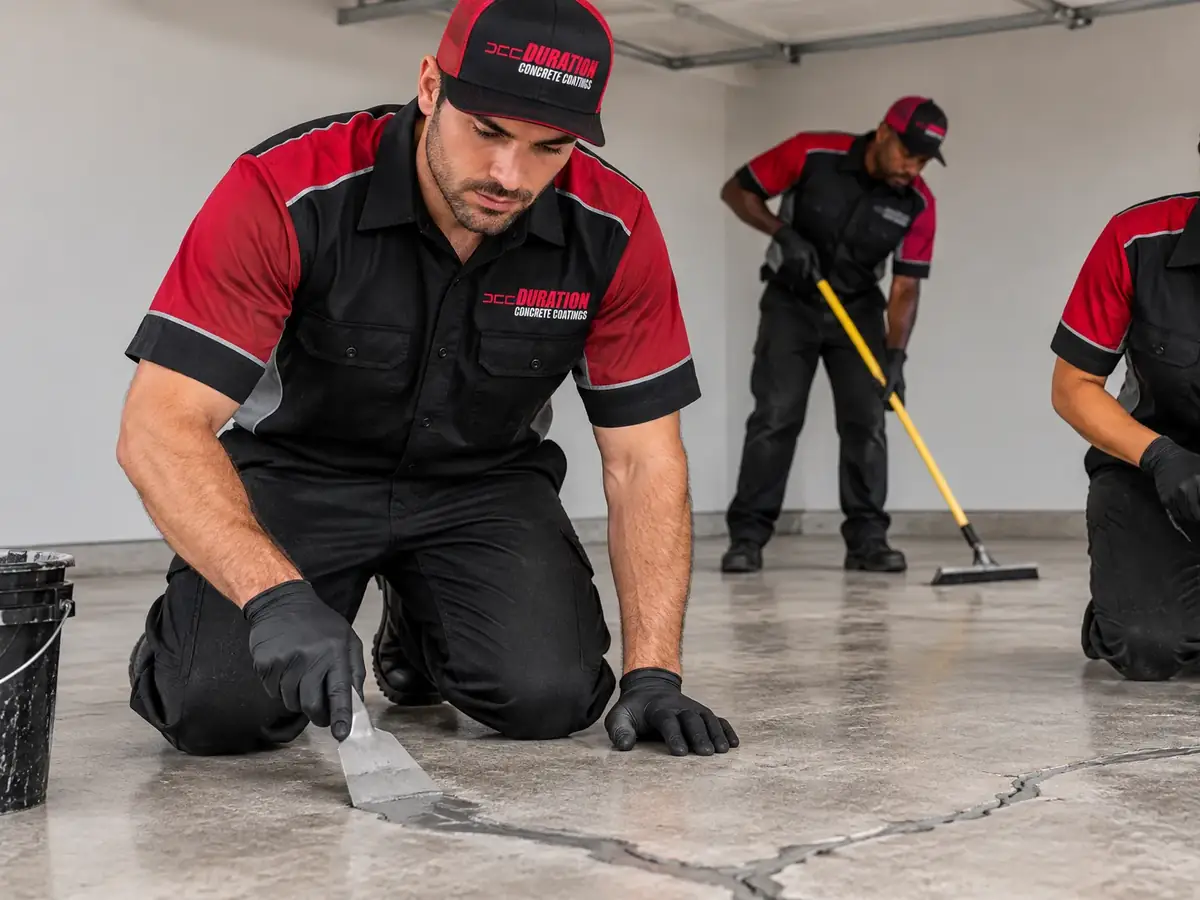
Chase and fill cracks, patch spalls, and detail around sumps and drains.
Moisture-Test
Run a calcium-chloride or relative-humidity test on the slab.
Mitigate If Needed
Where moisture reads high, apply a vapor-mitigation primer before coating.
Base and Chips
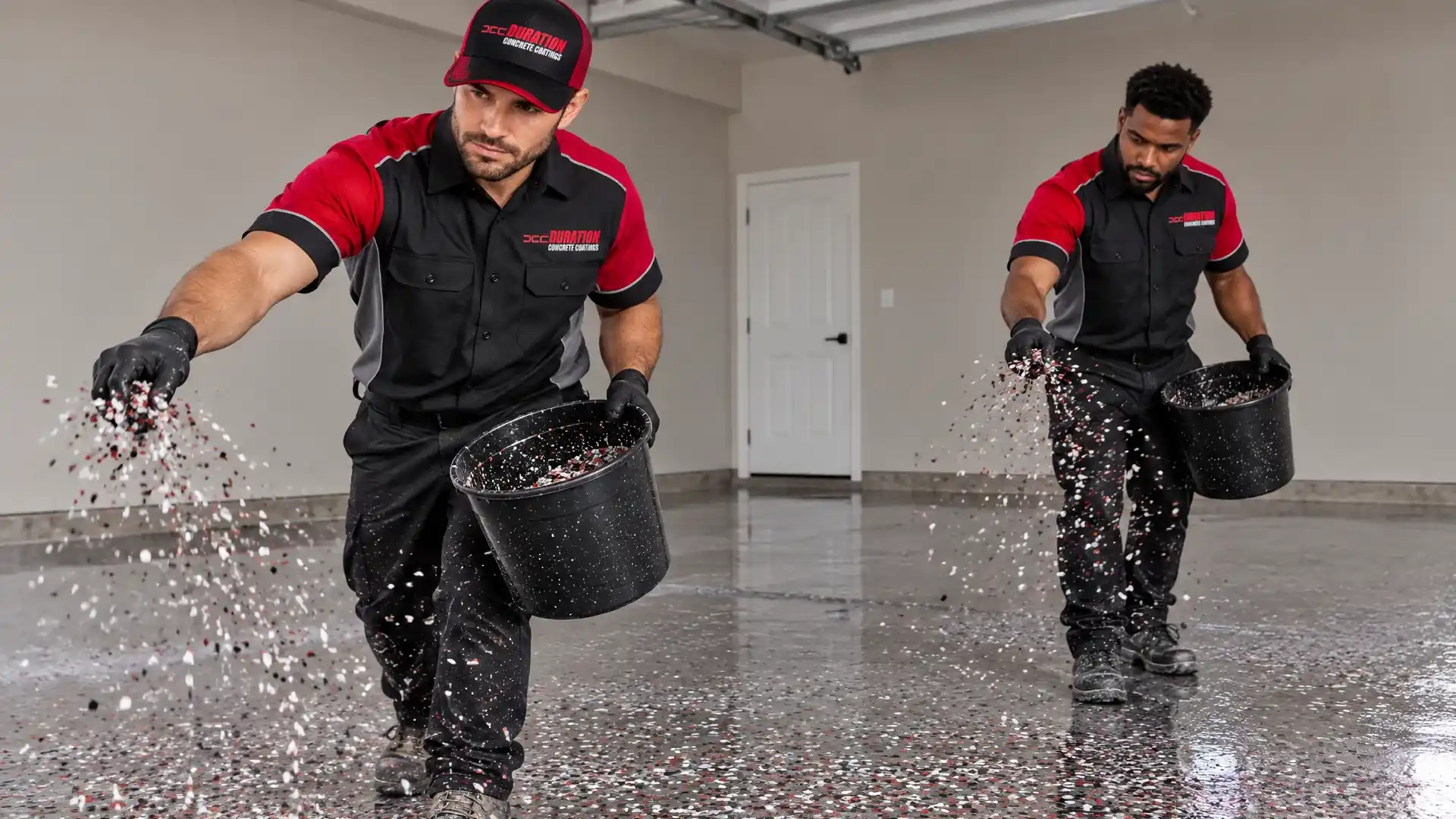
Apply the base coat and broadcast your chosen chip blend.
Topcoat and Inspect
Seal with the clear topcoat and walk the floor with you.
How We Test a Basement Slab for Moisture
We use two standard tests. A calcium-chloride test (ASTM F1869) measures how much moisture vapor comes off the slab over a 24-hour period, and a relative-humidity probe set into the concrete (ASTM F2170) reads the moisture deeper in the slab. As a working rule, a calcium-chloride result above about 3 pounds per 1,000 square feet per 24 hours, or an in-slab relative humidity above roughly 75 to 80 percent, tells us the floor needs a vapor-mitigation primer before any decorative coating goes down. That one test is the difference between a basement floor that lasts and one that blisters a few months later.
Which Basement Coating Is Right for You
| System | Recommended for |
|---|---|
| Polyaspartic (Duralast) | A fast, flexible, one-day finish with the widest chemical and moisture tolerance |
| Epoxy | A cost-effective decorative floor on a dry, tested slab |
| Vapor-mitigation primer + coating | A slab that tests high for moisture |
We recommend the right one after we see and test your floor, not before.
Colors, Comfort and Cleanup
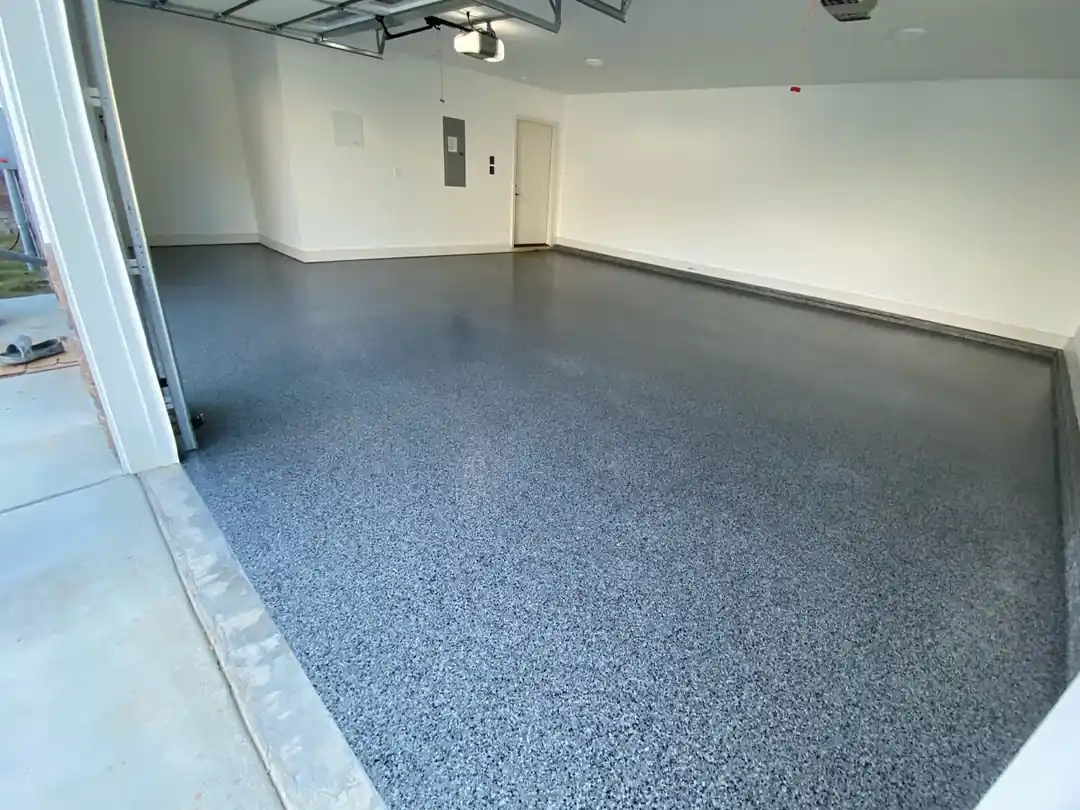
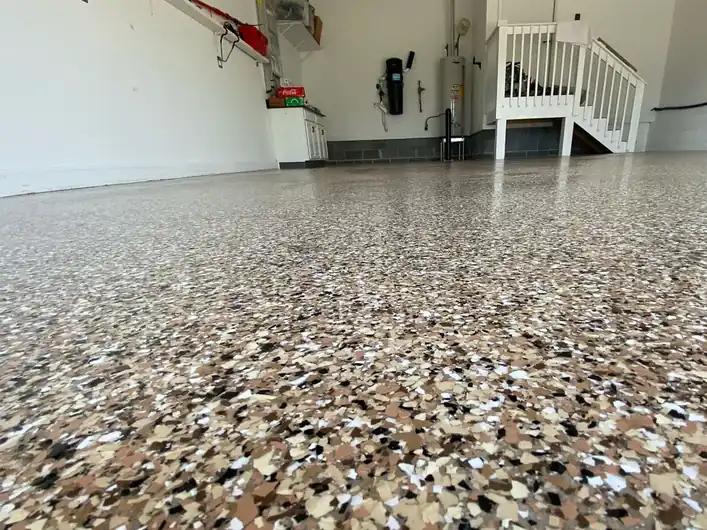
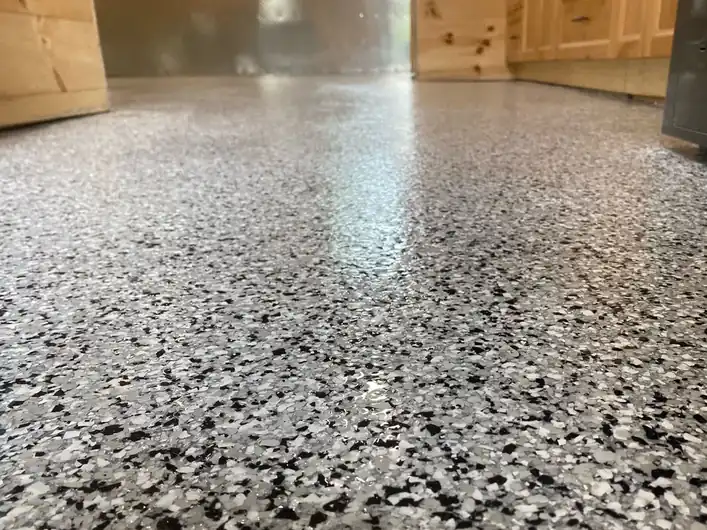
A coated basement floor comes in a huge range of chip and flake blends, well over a thousand combinations, so you can match a finished basement, a home gym or a workshop. Beyond looks, the sealed surface resists mold and musty odors, wipes clean instead of holding dust, and is warmer and brighter than bare gray concrete.
Coating Thickness and Cure Times
A finished chip-broadcast system builds to roughly 20 to 40 mils, many times the thickness of a basement floor paint, which is part of why it holds up to foot traffic, moisture and cleaning. Cure times with our polyaspartic system are short and predictable:
| Use | Ready after |
|---|---|
| Walk on it | about 24 hours |
| Move furniture back | about 48 hours |
| Full use | about 72 hours |
The Duralast polyaspartic is rated at 2,900 psi tensile strength. Compared with a painted or sealed slab, that is a floor you can rely on rather than reapply every couple of years.
Radon Slabs and Sump Systems
If your basement has a radon-mitigation system or a sump pit, we coat around and up to them without interfering with how they work. We seal the slab surface, not the drainage or the sub-slab venting your basement relies on, so you get a finished, decorative floor and keep your moisture and radon management fully intact. We detail cleanly around posts, drains and the sump lid so the finished floor looks deliberate, not patched.
What a Basement Floor Coating Costs
- Square footage of the basement.
- Slab condition and crack or spall repair.
- Moisture level, a high-moisture slab needs a mitigation primer, which adds a step.
- Coating system and finish you choose.
A basement floor coating typically runs about $5 to $8 per square foot in our market. We price it with a free on-site estimate and give you a firm number in writing.
Where We Install Basement Floor Coatings
We coat basements across Fort Wayne, Northeast Indiana and adjacent Northwest Ohio, including Fort Wayne, New Haven, Huntertown, Auburn, Leo-Cedarville, Woodburn, and Van Wert, Bryan, Paulding and Defiance in NW Ohio. (See all service areas)
Our General Manager Is on Every Job
Founded in 2014, Duration keeps general manager Dan Diven on-site for every job, with a crew of 10 and 4,500 projects across Fort Wayne and Northeast Indiana, holding a 5.0 rating from 102 Google reviews.