
Our Service
Epoxy or Polyaspartic? the Short Answer for Fort Wayne
For most Fort Wayne garages and outdoor slabs, polyaspartic outperforms epoxy because it cures faster, stays flexible in the cold, and will not yellow in sunlight. Epoxy still has its place indoors and on budget commercial projects, so we fit the resin to the job rather than selling one system for everything. Whichever we recommend, the prep is the same and the work carries a lifetime warranty. Book a free estimate and we will tell you which is right for your floor and why.
Why Epoxy Fails in Indiana Garages (and Where It Still Works)
Epoxy is a two-part coating that cures slowly by chemical reaction, usually over several days. That slow cure is the root of its weaknesses in this climate:
- Cold-brittle. Epoxy needs the slab above roughly 50 degrees to cure well, and once cured it is harder and less flexible, so a freeze-thaw slab can crack it loose.
- Yellowing. Standard epoxy ambers under UV, so a garage floor near a sunny door fades unevenly. Polyaspartic is UV-stable and does not.
- Slow return to service. Epoxy can keep a garage out of use for days, where our polyaspartic system is ready to walk on in about 24 hours.
Where epoxy earns its keep is a heated, indoor slab, a basement, or a budget commercial floor that will not see cold or sun. There we will happily install a quality epoxy system.
The Honest Comparison, With Numbers
Most companies claim epoxy is weaker without showing why. Here is the real difference, side by side:
| Property | Epoxy | Duralast polyaspartic |
|---|---|---|
| Cure to foot traffic | days | about 24 hours |
| Install time | 2 to 3 days | one day |
| Cold weather | needs 50 degrees plus | cures in cold |
| UV stability | yellows | UV-stable |
| Flexibility | more brittle | stays flexible |
| Tensile strength | lower | 2,900 psi, up to 5x epoxy |
Our Prep Does Not Change
Whether we install epoxy or polyaspartic, we diamond-grind the slab for a real bond, chase and patch cracks and spalls, and moisture-test the concrete before priming. A coating is only as good as the concrete under it, and skipping prep is why bargain jobs peel here.
(Compare our one-day polyaspartic system · See garage floor coating)
Our General Manager Is on Every Floor
Founded in 2014, Duration keeps general manager Dan Diven on-site for every job, with a crew of 10 and 4,500 projects across Fort Wayne and Northeast Indiana, holding a 5.0 rating from 102 Google reviews.
Where Epoxy Fits, and Where We Recommend Polyaspartic
Epoxy is a strong, cost-effective choice for a heated indoor slab, a basement, or a budget commercial floor that will not see cold or direct sun. We steer you toward polyaspartic for garages, outdoor patios and pool decks, and any floor exposed to Indiana freeze-thaw, road salt or UV, because polyaspartic holds up where epoxy gets brittle or yellows. On your free estimate we tell you which fits your floor and why, rather than selling one system for everything.
Types of Epoxy Systems We Install
- Solid-color epoxy for a clean, uniform floor.
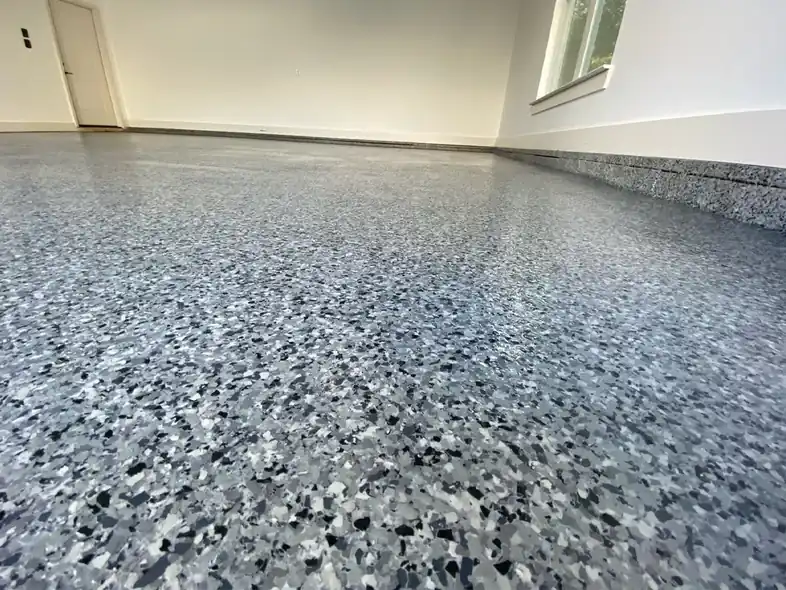
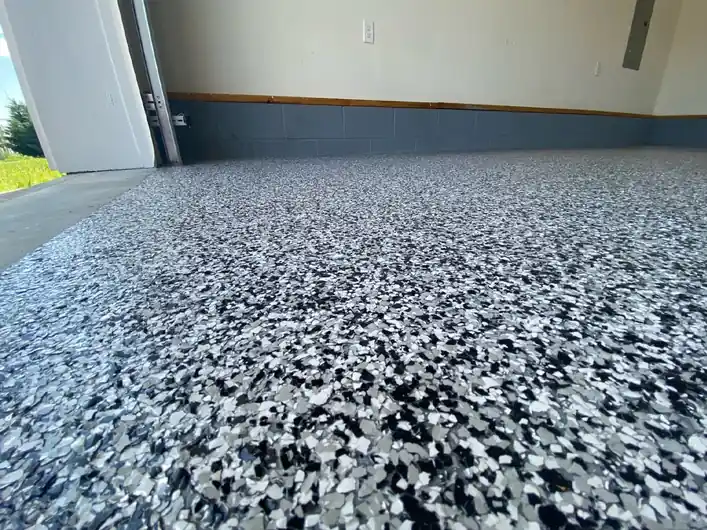
- Decorative chip epoxy for texture, grip and a garage-ready look.
- Metallic-style epoxy for a high-gloss showroom finish.
- Epoxy base with a polyaspartic topcoat, the hybrid we often recommend so you get epoxy's build with polyaspartic's UV stability and one-day cure.
Every one is diamond-ground, repaired and moisture-tested before we prime.
What Affects Your Epoxy Flooring Price
- Square footage of the space.
- Slab condition and how much crack repair and grinding it needs.
- System build, a single-coat epoxy versus a multi-coat system with a topcoat.
- Finish, solid color, decorative chips or a metallic-style look.
- Moisture, a damp slab needs a mitigation primer first.
We price every floor with a free on-site estimate, not a fixed online number, because the slab decides the cost.
Where We Install Epoxy Flooring
We coat floors across Fort Wayne, Northeast Indiana and adjacent Northwest Ohio, including:
Do not see your town? We very likely cover it. (See all service areas)
Caring for Your Coated Floor
A coated floor is far easier to keep clean than bare concrete, and a little care keeps it looking new for years. Sweep or dust-mop as needed, and clean with a soft mop and warm water or a mild pH-neutral cleaner. Wipe up oil, chemicals and de-icer when you notice them, though the coating resists staining. Avoid harsh solvents and abrasive pads, which can dull the finish over time. That is the whole maintenance routine, no waxing, resealing or stripping the way a bare or painted slab needs.